


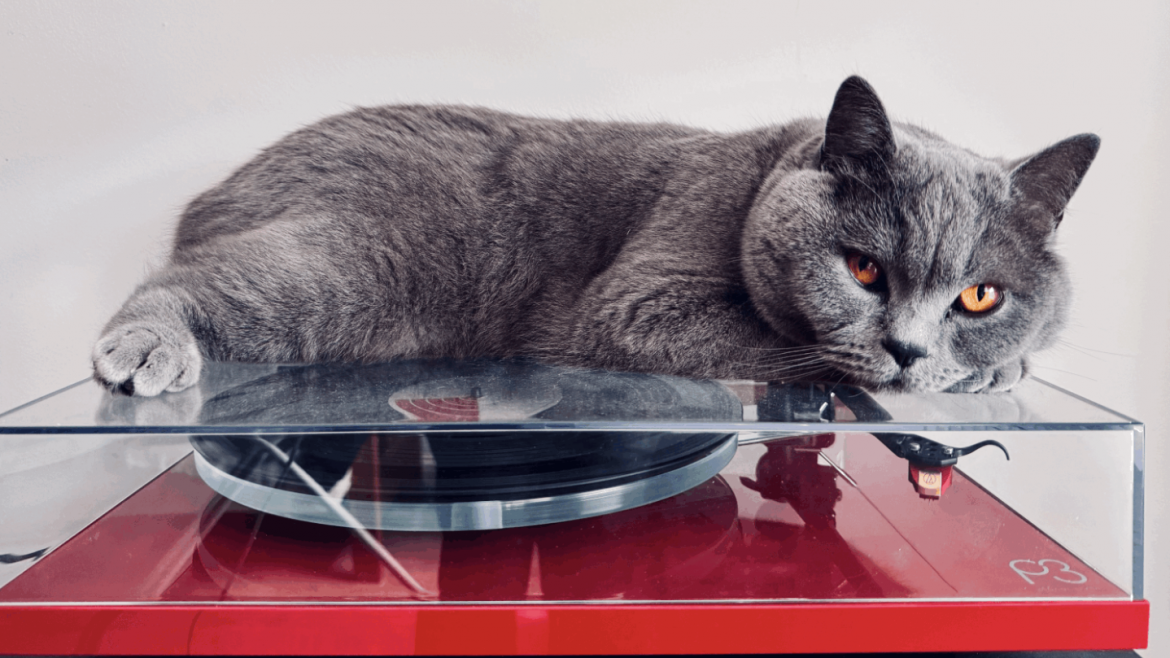
Once Upon a Time, There Was the Rega Planar: The Resonance Hidden Beneath the Music
https://directsoundrecords.com/wp-content/uploads/2026/07/Tenebra-DSRs-Cat-1024x639.png 1024 639 Michelangelo Michelangelo https://secure.gravatar.com/avatar/89c9d8d7e3cacdd3a1530cf562ec5e1b4de2198dbb8a6dd62b550b23ac888854?s=96&d=mm&r=gA turntable does not operate in isolation. Tonearm mass, cartridge compliance, mounting hardware, furniture, floors and walls all participate in the result. Resonance Lab was created to make those relationships visible—before uncertain listening impressions become unnecessary purchases or endless adjustments.
Once upon a time, there was Rega.
Not Rega as an object of endless forum debate. Not Rega as a flag to be waved in the eternal arguments between belt drive and direct drive, low mass and high mass, suspended designs and rigid plinths.
Rega as an idea.
A simple, almost stubborn idea: remove what is unnecessary, make rigid what must remain still and avoid allowing unwanted energy to accumulate within the structure.
Perhaps that is why a Rega Planar 3 can still appear both modern and slightly old-fashioned. Modern because it is visually restrained, mechanically purposeful and free from excessive mass. Old-fashioned because it recalls a period of British hi-fi in which products often appeared to have been designed to solve practical problems rather than to resemble industrial monuments.
These were not domestic altars constructed from huge slabs of metal and acrylic. They were comparatively light, intelligent instruments intended to operate in real homes.
And this is where the story becomes interesting.
Lightness Is a Design Decision
The Rega Planar 3 is simple, but it is not simplistic.
Rega describes the Planar 3 as using a lightweight laminated plinth reinforced between the tonearm mounting and main bearing by its double-brace structure. The intention is to increase rigidity where it is required without turning the complete plinth into a large energy-storing mass.
This philosophy differs from the approach of a turntable that attempts to resist vibration primarily through weight.
A low-mass, high-rigidity design aims to minimise stored energy and reduce the duration of unwanted resonances within the structure. Rather than trying to become an immovable object, it attempts to manage energy quickly and predictably.
But every engineering philosophy creates conditions under which it performs best.
A lightweight turntable may respond differently to its support and surrounding structure than a very heavy, highly damped design. The equipment table, floor and wall are not automatically external to the turntable system. Under some conditions, they become part of it.
A Rega must therefore be given the right environment in which to behave like a Rega.
That does not always happen.
A Planar 3 on a Suspended Wooden Floor
The system in this case consisted of a modern Rega Planar 3 with its RB330 tonearm and an Audio-Technica AT-OC9XML moving-coil cartridge.
It was an interesting combination. The Microlinear stylus and boron cantilever of the AT-OC9XML offered excellent tracking potential, while the RB330 provided the rigid, low-friction platform around which the Planar 3 had been designed.
The turntable was positioned on a good-quality equipment table.
The table, however, stood on the suspended wooden floor of an English house.
The result was good, but not memorable.
It was controlled, detailed and pleasant, yet it did not quite deliver the immediacy, rhythm and physical presence often associated with a well-installed Rega.
The bass was present but did not feel completely secure. The soundstage opened, but it did not always seem to lock firmly into place. Voices were clear, yet the central image lacked some of the natural solidity that can transform competent reproduction into a convincing musical event.
None of this amounted to an obvious malfunction.
The stylus did not jump. There was no dramatic feedback, no clearly audible mechanical noise and no single defect that could be isolated immediately.
The system simply appeared to play with a small hesitation hidden beneath the music.
The Traditional Audiophile Response
The first instinct in situations like this is often to begin changing things.
We change the interconnect. We try another platter mat. We suspect the cartridge. We adjust tracking force, vertical tracking angle, azimuth and anti-skating. Eventually, we spend an afternoon staring at the tonearm as though it were about to confess.
Audiophiles know this ritual well.
When something does not sound quite right, the mind generates possible explanations faster than they can be tested. Some are technically reasonable. Others are elegant methods of converting uncertainty into maintenance.
Before changing anything, however, it is worth asking a simpler question:
What is the expected mechanical behaviour of the tonearm and cartridge combination?
The Tonearm and Cartridge Resonance
A cartridge suspension behaves like a spring, while the effective moving mass of the tonearm, cartridge and mounting hardware behaves like a mass attached to that spring.
Together they form a resonant mechanical system.
The commonly used estimate is:
fr = 159 / √(M × C)
where:
- fr is the estimated resonance frequency in hertz;
- M is the total moving mass in grams;
- C is the cartridge’s dynamic compliance around the resonance region, expressed in µm/mN or an equivalent compliance unit.
For this system, the published and estimated inputs were:
- RB330 effective mass: 11 g;
- AT-OC9XML cartridge mass: 7.6 g;
- mounting screws and washers: approximately 1–1.5 g.
This produces a total moving mass of approximately 19.6–20.1 g.
The Compliance Problem
The next figure is less straightforward.
Audio-Technica specifies the AT-OC9XML’s dynamic compliance as 16 × 10⁻⁶ cm/dyne at 100 Hz.
Tonearm and cartridge resonance, however, normally occurs much lower, generally somewhere around the single-digit or low-double-digit hertz region. A compliance value measured at 100 Hz cannot simply be inserted into the formula as though it described the suspension identically at 10 Hz.
Compliance is frequency-dependent, and manufacturers do not all publish it under the same test conditions.
Enthusiasts and designers therefore sometimes apply a practical conversion multiplier to Japanese 100 Hz specifications. Values between approximately 1.5 and 2 are commonly explored, but this is a heuristic—not a universal physical conversion law.
Using a factor of 1.7 gives an estimated 10 Hz compliance of:
16 × 1.7 = 27.2 µm/mN
Entering that estimate into the resonance formula gives:
159 / √(19.6 × 27.2) ≈ 6.9 Hz
With the slightly greater mass estimate of 20.1 g, the result becomes approximately:
159 / √(20.1 × 27.2) ≈ 6.8 Hz
The calculation therefore suggests a resonance around 6.8–6.9 Hz under that particular compliance assumption.
But the decimal places must not seduce us into believing that the estimate is more precise than the input data.
If different plausible conversion assumptions are explored, the predicted resonance can move approximately between 6.3 and 7.3 Hz. The real cartridge suspension may also differ from the nominal specification, and mounting conditions can affect the result.
The honest conclusion is therefore not:
“This combination resonates at exactly 6.86 Hz.”
It is:
“This combination is likely to operate near the lower end of the generally preferred resonance region and deserves closer attention.”
What a Low Estimate Actually Means
A predicted resonance below the centre of the preferred range does not automatically mean that the tonearm and cartridge are unusable together.
Ortofon currently describes approximately 7–12 Hz as an optimal region, with 10 Hz as a useful target. It also notes that values around 6.5–7 Hz may still be usable without problems.
This makes the distinction between a warning and a verdict extremely important.
A result near 6.8 or 6.9 Hz does not say:
“Remove this cartridge immediately.”
It says:
- the combination may be more sensitive to record warps;
- subsonic energy deserves attention;
- the turntable support may become particularly important;
- structural movement should not be dismissed;
- and calculated behaviour should ideally be checked against observation or measurement.
The system was not necessarily wrong.
It was potentially delicate.
Where Resonance Lab Becomes Useful
This is the purpose of Resonance Lab.
It does not replace listening, and it does not convert analogue reproduction into a simple pass-or-fail calculation.
It provides a structured way to examine the relationship between tonearm effective mass, cartridge weight, mounting hardware and compliance.
Most importantly, it allows the user to see how assumptions change the result.
In a case such as the AT-OC9XML, the compliance conversion should not be hidden behind an apparently unquestionable number. It should be explored.
What happens if the effective compliance is closer to 24 µm/mN?
What happens if it is closer to 27 or 32?
What is the effect of an additional gram of mounting mass?
Would a lighter cartridge move the resonance significantly?
Does the result remain comfortably inside the desired region, or is it strongly dependent on uncertain inputs?
This is more informative than asking whether two products are merely “compatible.”
Compatibility is rarely binary.
A combination may be:
- comfortably matched;
- technically usable but sensitive to its environment;
- dependent on uncertain compliance data;
- or sufficiently extreme to justify reconsideration.
Resonance Lab makes that uncertainty visible.
What Resonance Lab Does Not Do
A calculation cannot measure a moving floor.
It cannot determine the actual structural resonance of an equipment rack, quantify footfall vibration or prove that a wall shelf will improve every system.
It also cannot know the exact low-frequency compliance of an individual cartridge unless that value has been measured under relevant conditions.
Resonance Lab therefore does not diagnose environmental vibration directly.
Its role is different: it helps identify whether the arm and cartridge combination makes environmental vibration a plausible and technically consistent part of the investigation.
In this case, it did not prove that the wooden floor was responsible.
It made the floor impossible to ignore.
The Floor Enters the System
Suspended wooden floors are elastic structures.
They move under footsteps and distribute low-frequency mechanical energy through joists, boards, furniture and equipment supports. The degree of movement depends on the building, span, construction, loading and position within the room.
This is not automatically a defect. It is simply the behaviour of the structure.
Anyone who has lived in an older English house knows that the building cannot be understood only by looking at it. It creaks, moves, breathes and responds.
An analogue turntable responds too.
When a tonearm and cartridge system is already operating near a relatively low resonance frequency, low-frequency structural movement may become more relevant. The interaction need not be dramatic enough to throw the stylus from the groove.
It may instead appear as:
- less articulate bass;
- a centre image that does not feel completely settled;
- reduced rhythmic certainty;
- slightly unstable spatial focus;
- or a vague sense that the performance is not firmly grounded.
These descriptions are subjective listening observations, not unique diagnostic signatures. Similar impressions can have many causes.
But when the calculated arm and cartridge behaviour points towards greater low-frequency sensitivity, the support structure becomes a rational variable to test before purchasing new components.
The Load-Bearing Wall
The turntable was moved from the equipment table to a high-quality wall shelf fixed to a solid load-bearing wall.
The listening change was substantial.
The bass did not simply become more abundant. It became easier to follow. Low notes felt less hesitant and more clearly connected to the musical line.
Transient definition improved. The soundstage became more stable. Voices gained a firmer centre, and instruments occupied more credible positions.
Most importantly, the reproduction acquired a stronger sense of continuity.
The music no longer seemed to pass through a succession of small, invisible obstacles.
It flowed.
This observation does not establish a controlled scientific comparison, and it does not prove that every Rega turntable should be wall-mounted.
It does, however, align with Rega’s own approach. The company produces a lightweight, rigid wall bracket specifically for the Planar 1, Planar 2, Planar 3 and Planar 6, describing it as a vibration-isolation solution intended to complement its lightweight turntables.
The shelf did not add musical information.
Good mechanical engineering rarely adds magic.
It removes interference.
A Case Study, Not a Universal Rule
Not every wooden floor is unsuitable for a turntable.
Not every equipment table performs poorly.
Not every Rega must be placed on a wall shelf, and not every wall is structurally appropriate for supporting one.
A concrete floor and a stable rack may provide excellent conditions. A poorly installed wall shelf may create its own problems. A different tonearm and cartridge combination may be less sensitive to low-frequency movement.
The purpose of this case is not to produce another audiophile commandment.
It is to demonstrate a better sequence of reasoning:
- Describe the listening problem without immediately deciding its cause.
- Check the published mechanical specifications.
- Model the tonearm and cartridge resonance.
- Identify uncertainty in the compliance data.
- Explore plausible scenarios rather than trusting one exact number.
- Consider the support and building structure.
- Change one meaningful variable.
- Listen again—and measure where possible.
This is far more useful than changing three accessories simultaneously and then attempting to remember which one supposedly transformed the system.
Why I Created Resonance Lab
Tonearm and cartridge resonance has remained unnecessarily mysterious for too long.
The subject often sits somewhere between textbook equations, manufacturer specifications expressed under different conditions, enthusiast-produced compatibility charts and forum discussions in which every confident statement is followed by another confident statement claiming the opposite.
Resonance should not be an initiation ritual.
It should not be reserved for people who enjoy calculations more than music.
It should be a practical tool for better decisions.
I created Resonance Lab to make the relationship understandable and explorable.
The app does not tell the user what to hear. It helps organise the variables that may explain what they are hearing.
It can help reveal whether a combination is:
- comfortably within a preferred region;
- near a boundary;
- highly dependent on an uncertain compliance conversion;
- or potentially sensitive to environmental conditions.
It can also help prevent expensive misdiagnoses.
A new cartridge will not solve a moving floor if the replacement produces the same mechanical relationship. A different mat will not correct an unsuitable arm and cartridge match. A heavier mounting plate may move the resonance in the wrong direction.
Sometimes the most important upgrade is not another component.
It is a clearer understanding of the system already in front of us.
From Calculation to Reality
The calculated resonance frequency is a starting point, not the final truth.
Where possible, it should be complemented by real-world observation or measurement using a suitable test record and analysis method.
A measured result can reveal the actual resonance peak of the installed system, including the behaviour of the individual cartridge suspension rather than only its nominal specification.
Calculation and measurement serve different purposes:
- calculation helps evaluate combinations before purchase and explore alternatives;
- measurement reveals how the installed system actually behaves;
- listening tells us whether that behaviour is musically significant in the complete system.
None should be forced to perform the role of the others.
The strongest diagnosis emerges when all three point in the same direction.
Understanding Rega Without Worshipping It
Understanding this case does not require worshipping Rega as a brand.
It requires understanding why its design choices make sense.
A Rega is not “simple” in the impoverished sense of the word. It follows a specific path based on lightness, rigidity and controlled energy behaviour.
But a specific design philosophy also requires a suitable context.
Place the turntable on a structure that moves, and under certain conditions it may tell you.
Give it a stable mechanical reference, and it may stop defending itself and begin to communicate the music more freely.
Perhaps this is one reason Rega has retained such a distinctive identity. When the system is working well, the turntable does not seem to be trying to impress the listener.
It simply allows the performance to pass through.
The Relationship Beneath the Music
A turntable is not a collection of isolated products.
The tonearm, cartridge, compliance, mounting screws, support, floor, walls and furniture all participate in its mechanical behaviour.
Sometimes their influence is obvious.
At other times, it does not add a recognisable defect. It removes certainty.
That is the deeper purpose of Resonance Lab.
It does not replace the ears, and it does not promise to solve every analogue problem through a formula.
It makes relationships visible.
In this case, the app showed that the RB330 and AT-OC9XML combination was not absurd, but potentially sensitive. That made the suspended floor a credible variable rather than a piece of inherited audiophile folklore.
The wall shelf then became more than an accessory recommended by tradition.
It became a mechanical response to a specific hypothesis.
Once upon a time, there was Rega.
But Rega is still here.
To hear it properly, we may simply need to understand where it came from, what it is trying to achieve and the environment in which we are asking it to perform.
Because in analogue reproduction, sound never comes from one component alone.
It comes from a relationship.
And sometimes, to rediscover the music, we do not need to replace the turntable.
We simply need to remove the floor from the conversation.
Explore Resonance Lab
Resonance Lab helps vinyl enthusiasts explore tonearm and cartridge compatibility, estimate system resonance and compare how changes in mass or compliance may influence the result.
Learn more about Resonance Lab
Download Resonance Lab from the App Store
References and Technical Sources
- Rega Research. “Planar 3.”
View official product information
- Rega Research. “RB330 Tonearm.”
View official specifications
- Audio-Technica. “AT-OC9XML Dual Moving-Coil Stereo Cartridge.”
View official specifications
- Ortofon. “Matching Cartridges with Tonearms.”
View resonance formula and guidance
- Rega Research. “Turntable Wall Bracket.”
View official product information
This article describes a real-world setup and subjective listening observations supported by resonance modelling. Calculated resonance values are estimates and depend on the accuracy and measurement frequency of the compliance data. They should not be interpreted as a substitute for direct measurement of the installed system.