Where High Fidelity Really Begins: Four Decisions That Shape a Believable Stereo Recording
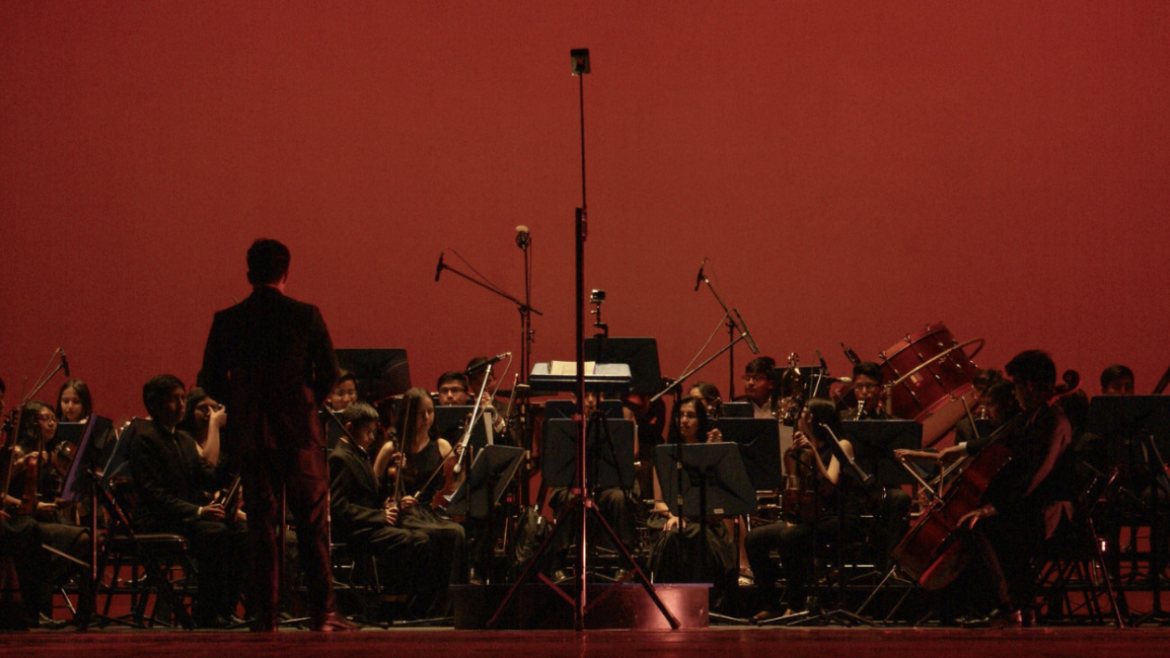
https://directsoundrecords.com/wp-content/uploads/2026/07/Screenshot-2026-07-25-at-20.44.29-1024x582.png 1024 582 Michelangelo Michelangelo https://secure.gravatar.com/avatar/89c9d8d7e3cacdd3a1530cf562ec5e1b4de2198dbb8a6dd62b550b23ac888854?s=96&d=mm&r=gHigh fidelity begins before mastering, before the distribution format and before the physical or digital medium. It begins with the decisions made when the performance is captured: how stereo space is encoded, how phase relationships are managed, how far the microphones are placed from the musicians and which microphones are chosen to translate that perspective.
Listening to a stereo recording involves much more than hearing sound emerge from two loudspeakers.
A voice apparently positioned in the centre does not come from a hidden central speaker. An instrument heard slightly to the left is not physically present at that point in the listening room. The apparent depth extending beyond the wall behind the system is not an acoustic space that has suddenly opened in front of us.
These are perceptual constructions.
The auditory system interprets differences in level, timing, spectrum and phase, together with reflections and the relationship between direct and reverberant sound. From this information, it creates a plausible auditory scene.
Stereo recording is therefore not merely the process of producing two channels. It is the art of creating relationships that the listener’s brain can interpret as space.
A High-End System Cannot Invent the Recording
A recording may be highly detailed, dynamically impressive and extended at both ends of the frequency spectrum while still failing to sound believable.
It may reveal the smallest movements of the musicians but construct no stable image. It may sound extremely wide but imprecise. It may attract attention immediately and gradually become artificial or tiring.
For listeners using loudspeakers, this distinction is fundamental.
A revealing system can expose the spatial quality of a recording, but it cannot manufacture coherence that was never captured. If the central image is unstable, the playback equipment may reveal that instability with greater clarity. If the relationship between instruments and ambience is implausible, additional resolution may make the contradiction more obvious.
The format and reproduction chain matter enormously, but they inherit the decisions made at the beginning.
High fidelity starts at the microphone.
Stereo Is Not Simply Width
In audiophile language, we often speak about soundstage, imaging, depth, focus and air around instruments.
These are useful descriptions, but a believable soundstage is not simply a wide one.
Width can be created in many ways:
- spaced microphones;
- pan controls;
- interchannel delays;
- Mid-Side processing;
- stereo reverberation;
- decorrelation;
- and dedicated spatial processors.
All of these can be artistically valid. But increasing width does not automatically increase realism.
A believable voice should remain stable in the centre, not only in lateral position but also in physical presence. A piano should have plausible dimensions. A guitar should not become wider than the performer playing it unless that enlargement is an intentional artistic decision. A flute should not be reduced to breath, lips and key noise while losing the integrated sound of the instrument.
The acoustic environment should not feel as though it has been placed behind the musicians as an independent effect. It should appear to belong to the same event.
When a recording is coherent, the listener perceives more than individual sources distributed between two loudspeakers. The listener perceives relationships between the instruments, their apparent distances and the room surrounding them.
That is what makes a soundstage credible.
The Four Decisions Behind a Believable Recording
Four closely connected decisions have a particularly strong influence on spatial realism:
- the stereo microphone technique;
- the timing and phase relationships between channels;
- the distance between microphones and performers;
- and the microphone characteristics used at that distance.
None of these choices operates independently.
Changing microphone distance changes the balance between direct sound and room ambience. It also changes proximity effect, source integration, off-axis contribution and the amount of environmental noise captured.
Changing the microphone changes the polar pattern, tonal balance, transient behaviour, self-noise and off-axis response experienced at that distance.
Changing the stereo array changes the interchannel timing and level relationships supplied to the reproduction system.
The art lies in making these decisions support the same perceptual objective.
1. Stereo Technique: Different Ways of Encoding Space
Stereo microphone techniques are not simply alternative arrangements for producing a left and right channel. They encode spatial information in fundamentally different ways.
Spaced Pairs
In an AB arrangement, two microphones are separated physically. A sound arriving from one side normally reaches one microphone before the other, producing an interchannel time difference. Depending on the source, microphone pattern and geometry, differences in level may also occur.
Spaced arrays can create a broad impression of scale and envelopment. In a good concert hall, and particularly with larger ensembles, this can communicate openness, low-frequency spaciousness and the feeling that the performance breathes within a large acoustic environment.
Physical spacing also introduces frequency-dependent phase relationships between the channels. In stereo these can contribute to spaciousness, but they may reduce localisation precision or create tonal changes when the channels are summed or partially combined.
This does not make AB inherently defective. It means that width, envelopment, localisation and mono compatibility must be balanced deliberately.
Near-Coincident Techniques
Near-coincident arrangements such as ORTF, NOS and DIN combine physical microphone spacing with directional polar patterns.
ORTF, for example, uses two cardioid microphones separated by 17 centimetres and angled 110 degrees apart. The resulting stereo image contains both interchannel timing and level differences.
This can offer a productive compromise: greater spaciousness than many coincident cardioid arrangements, together with more definite image positioning than a widely spaced pair.
The timing component is not an accidental defect. It is part of the intended spatial design.
Coincident Techniques
In coincident arrangements such as XY, Mid-Side and Blumlein, the microphone capsules are placed as close as physically possible to the same acoustic point.
Because the direct sound reaches both capsules at approximately the same time, directional information is created primarily through differences in level and polarity produced by the microphones’ polar patterns.
Coincident geometry generally offers:
- stable localisation;
- a clearly defined central image;
- predictable mono compatibility;
- and fewer time-delay interactions introduced by microphone spacing.
The soundstage can sometimes appear less expansive than that produced by a spaced array, but individual positions may be easier to read.
Practical coincidence is never perfect. The capsules have physical dimensions, and real microphones exhibit frequency-dependent polar and phase responses. Careful construction and positioning still matter.
No Technique Is Universally Superior
The appropriate technique depends on:
- the size and arrangement of the ensemble;
- the acoustic character of the venue;
- the required balance between localisation and spaciousness;
- the importance of mono compatibility;
- the intended listening perspective;
- and the expected playback system.
When scale and strong hall envelopment are priorities, a spaced arrangement may be highly effective. When image stability and coincident timing are central to the project, XY, Mid-Side or Blumlein may offer important advantages.
There is no universally correct technique.
There is only a technique whose characteristics are coherent with the recording’s purpose.
2. Phase: More Than a Technical Problem
In audio, phase is frequently discussed only when something has gone wrong.
We notice it when bass becomes thin, when a centre image loses solidity, when combining microphones produces tonal colouration or when a stereo recording behaves poorly in mono.
These are genuine problems, but phase is also part of spatial information.
Timing and phase relationships between channels can contribute to the perception of width, localisation, ambience and depth. However, the differences captured by two microphones are not identical to the binaural cues produced at two human ears.
Microphones have no head between them, no pinnae and no torso. They do not apply the listener-specific spectral transformations associated with natural localisation. Their spacing and polar patterns create a new encoding intended for reproduction through another system.
This distinction is crucial.
In conventional loudspeaker stereo, each ear hears both speakers. The listening room adds reflections, and the listener’s head modifies the signals again. The brain must interpret this combined information and construct phantom images.
A large interchannel delay can increase spaciousness without necessarily improving image precision. A coincident array reduces the timing differences introduced at capture, but it cannot eliminate every phase interaction in the room, microphone, loudspeaker or recording chain.
The meaningful objective is not perfect phase identity.
It is maintaining interchannel relationships that remain sufficiently consistent for the listener to construct a stable scene.
Phase and the Centre Image
A central phantom image is created when the loudspeakers provide the auditory system with compatible information suggesting that a source lies between them.
Equal level alone is not always sufficient to make that centre feel physical. The spectral and temporal content of the two channels must also support the same perceptual interpretation.
If multiple microphones capture one source with different delays, the resulting interference may change with frequency. The image can become less stable, and tonal character may vary according to the combination of channels and listening position.
This is one reason why microphone count should not be confused with information quality.
More microphones can offer flexibility, control and creative possibilities. They can also create more relationships that must be managed.
3. Microphone Distance: Where Proportion Begins
Microphone distance is fundamental to whether an instrument sounds credible through loudspeakers.
A close position can provide immediacy, clarity and extraordinary detail. It can reveal the movement of piano mechanics, a flautist’s breathing, fingers touching strings, valve noise, bow texture and the precise attack of every note.
These details can be fascinating and musically valuable.
But they are not always proportionate to the way the instrument would be heard from a natural listening position.
The danger is that detail becomes confused with realism.
The Instrument Must Reassemble
Acoustic instruments often radiate different frequency regions from different parts of their bodies and in different directions.
At very close range, a microphone hears one local part of that radiation field. Moving farther away allows those contributions to integrate more fully before reaching the capsule.
The piano can become one sounding body rather than a collection of strings, hammers and mechanical events. The guitar returns to plausible physical dimensions. The flute becomes more than the excitation point at the mouthpiece; it becomes an instrument projecting energy into the room.
Distance allows the instrument to reassemble itself.
Distance Introduces the Room
Moving a microphone away also changes the balance between direct and reflected sound.
More of the room enters the recording. Early reflections influence tone and localisation. Reverberation communicates scale and distance. Background noise and undesirable acoustic characteristics become harder to avoid.
The correct distance is therefore not simply the most natural one in theory. It is the distance at which source integration, clarity, instrumental body and room contribution reach the desired balance.
That point changes with every venue, ensemble and microphone.
Close Is Not Wrong
Close microphone placement should not be treated as inherently artificial.
Many musical genres depend on intimacy, isolation, impact or the ability to balance sources independently. A close perspective may be exactly right for the artistic language of the production.
The problem arises only when a local, magnified perspective is presented as though it were automatically more faithful because it reveals more detail.
Detail describes how much can be perceived.
Realism describes whether those details belong to a plausible whole.
4. Microphone Choice: An Instrument of Proportion
At a realistic recording distance, the microphone is not merely a transparent transducer.
It becomes an instrument of proportion.
Every microphone has a technical personality shaped by factors including:
- its operating principle;
- diaphragm or ribbon construction;
- polar pattern;
- frequency and phase response;
- off-axis behaviour;
- transient response;
- self-noise and sensitivity;
- grille and body geometry;
- electronics and transformers;
- and manufacturing tolerances.
No microphone is perfectly neutral under every condition.
A microphone that sounds impressive at close range may not be the right choice at several metres. A presence rise that creates attractive clarity nearby may make a distant recording feel thin or overly explicit. A microphone with excellent on-axis response but irregular off-axis behaviour may colour the room contribution as distance increases.
Conversely, a microphone whose polar pattern and tonal balance remain well controlled away from the axis may integrate the direct and reverberant fields more convincingly.
Ribbon and Condenser Microphones
The choice should not be reduced to a contest between ribbon and condenser technology.
Modern condenser microphones can provide extended bandwidth, low self-noise, high sensitivity and carefully controlled directional behaviour. These qualities can be invaluable for distant acoustic recording.
Some ribbon microphones offer a different balance: smooth high-frequency behaviour, figure-of-eight directivity and a substantial sense of instrumental body. These qualities can suit coincident Blumlein recording and certain natural-distance applications particularly well.
But the result depends on the individual microphone, not merely the category printed on its specification sheet.
A ribbon is not automatically warm or natural. A condenser is not automatically bright or analytical.
The meaningful question is:
Does this microphone, at this distance and in this room, preserve the proportions required by the music?
Proximity Effect and Tonal Perspective
Directional pressure-gradient microphones exhibit proximity effect: their low-frequency response increases as the source moves closer.
The effect is generally strongest with figure-of-eight patterns and is also present, to a lesser degree, with cardioid and related directional patterns. Pure pressure-operated omnidirectional microphones do not exhibit conventional proximity effect.
At very close distances, proximity effect may exaggerate bass and make a source appear larger than its natural scale. It can also be used creatively to provide weight, intimacy or authority.
As the microphone moves farther from the source, this low-frequency boost diminishes. The resulting change in tonal balance must be considered alongside the growing contribution of the room.
This is one reason why microphone choice and distance cannot be separated. The correct working distance is not established by geometry alone; it must also produce an appropriate tonal foundation.
The objective is not to enlarge the bass artificially. It is to preserve enough body for the instrument to remain physical without making it implausibly large.
Why Blumlein Deserves Particular Attention
Among coincident techniques, the Blumlein pair occupies a distinctive position.
It uses two figure-of-eight microphones mounted coincidently and angled 90 degrees apart. Direction is encoded primarily through level and polarity differences, while the rear lobes capture a substantial part of the surrounding acoustic environment.
This combination can provide:
- a stable central image;
- clearly organised lateral localisation;
- strong mono compatibility;
- and a naturally integrated representation of the room.
Blumlein is also demanding.
The room must contribute positively because sound arriving from behind the array is captured strongly. Placement is critical. The ensemble must balance acoustically, and the useful recording angle must suit its arrangement.
A poor room is revealed rather than concealed. An incorrect microphone position can produce too much reverberation, an inappropriate stereo spread or an imbalanced ensemble.
That apparent limitation is also part of the technique’s value.
A minimally manipulative method encourages the main problems to be solved before recording begins rather than postponed until post-production.
The Room Is Not an Effect Added Afterwards
At natural microphone distances, the room inevitably becomes part of the recording.
Not every space deserves that responsibility.
A room may be excessively dry, too small, mechanically noisy, confused in the lower frequencies or dominated by unattractive early reflections. When the room is unsuitable, a purist approach does not transform it into a virtue.
But when the acoustic environment supports the music, natural ambience can provide an unusually coherent relationship between source and space.
The early reflections, reverberant build-up, asymmetries, frequency-dependent decay and interaction with instrumental radiation all belong to one event.
They are not a separate layer added later.
They are part of the way the music happened.
Artificial reverberation can be beautiful, realistic and artistically indispensable. The distinction is not between legitimate natural sound and illegitimate processing.
The distinction is whether the reverberant information supports the same perspective and spatial logic as the direct sound.
When natural reverberation is captured successfully, the room does not sit behind the instruments.
It connects them.
What the Listener Can Evaluate
These ideas are relevant not only to recording engineers. They can also change how an audiophile evaluates recordings and equipment.
Instead of asking only how much detail is audible, how deep the bass extends or how wide the soundstage appears, listen for relationships.
Listen to the Centre
Does a central voice feel stable and physical, or merely like a thin point suspended between the speakers?
Does its position and body remain coherent as pitch, intensity and register change?
Listen to Instrumental Proportion
Do the instruments possess believable dimensions?
Does the piano appear as one body, or as a series of enlarged local details? Does a guitar occupy plausible space? Does a flute retain tone and projection rather than becoming mostly breath and mechanism?
Listen to Complexity
Does the soundstage remain intelligible when the musical texture becomes dense?
A recording may appear sharply separated during a simple passage and lose all spatial organisation when multiple instruments play simultaneously.
Listen to Decay
Do notes decay continuously into the same environment in which they began?
Does a piano chord dissolve naturally into the surrounding space? Does the room respond to the music, or does the reverberation seem to operate as a separate layer?
Listen at Moderate Volume
A spatially coherent recording often remains intelligible without being played loudly. The centre continues to exist, instrumental positions remain readable and the acoustic environment still suggests depth.
Exaggerated spectral balance and artificial spatial effects may depend more strongly on level to remain impressive.
Listen for Credibility, Not Size
A realistic instrument does not need to sound enormous.
It needs to sound plausible.
Many recordings impress by enlarging everything. Enlargement can be artistically exciting, but it is not automatically high fidelity.
The Format Preserves; It Does Not Create
Audiophile discussions often concentrate on formats: vinyl, analogue tape, PCM, DSD and high-resolution distribution.
These discussions matter, but the format is sometimes treated as though it were the original source of realism.
A format can preserve captured information with greater or lesser accuracy. It cannot create spatial information that was never recorded.
If the soundstage is unstable, the medium preserves that instability. If the centre is weak, a particular format may alter the subjective presentation but cannot reconstruct the original microphone geometry. If the ambience bears no coherent relationship to the instruments, greater resolution may simply reveal that separation more clearly.
The format matters—but it comes later.
This does not diminish the value of excellent recording and distribution formats. It clarifies their purpose.
A high-quality medium is most meaningful when it is preserving something worth preserving:
- musical dynamics;
- instrumental timbre;
- temporal relationships;
- spatial information;
- natural decay;
- and believable proportion.
High Fidelity as Coherence
Stereo technique determines how spatial cues are encoded.
Phase and timing relationships influence image stability, width and the behaviour of combined signals.
Microphone distance determines the proportion between source, detail and environment.
Microphone choice determines how that distance is translated tonally and spatially.
The room either contributes meaningfully to the performance or becomes another problem to manage.
The recording format preserves these decisions but cannot replace them.
For Direct Sound Records, this is the foundation of natural acoustic recording. The objective is not to impose a spectacular soundstage but to preserve enough coherent information for the listener to reconstruct one.
A great recording does not necessarily astonish immediately.
It often becomes more convincing over time.
It does not enlarge every instrument. It preserves proportion. It does not use reverberation merely as decoration. It allows the acoustic environment to participate in the music.
Two loudspeakers can accomplish something extraordinary: they can suggest the presence of a space that does not physically exist in front of the listener.
For that illusion to succeed, the recording must contain believable information. It must respect the way we hear and provide the brain not only with individual sounds, but with meaningful relationships between them.
Perhaps this is where a recording becomes genuinely high fidelity—not when it reveals everything, but when it allows us to believe what we are hearing.
Related Articles
- The Space Between Sounds: How the Brain Reconstructs the Soundstage
- Why the Blumlein Pair Can Excel in Loudspeaker Playback
References and Further Reading
- Eargle, J. M. “An Overview of Stereo Recording Techniques for Popular Music.”
Journal of the Audio Engineering Society, 1986.
View AES record - Gerzon, M. A. “The Design of Precisely Coincident Microphone Arrays for Stereo and Surround Sound.”
Audio Engineering Society 50th Convention, 1975.
View AES record - Politis, A., Laitinen, M.-V., Ahonen, J. and Pulkki, V.
“Parametric Spatial Audio Processing of Spaced Microphone Array Recordings for Multichannel Reproduction.”
Journal of the Audio Engineering Society, 2015.
View AES record - DPA Microphones. “Stereo Recording Techniques and Setups.”
Read technical guide - DPA Microphones. “ORTF.”
View technical definition - Neumann. “What Is the Proximity Effect?”
Read technical guide - Bock, T. M. and Keele, D. B.
“The Effects of Interaural Crosstalk on Stereo Reproduction and Minimizing Interaural Crosstalk in Nearfield Monitoring.”
Audio Engineering Society 81st Convention, 1986.
View AES record - Schneider, M. “MS Mastering of Stereo Microphone Signals.”
Audio Engineering Society 132nd Convention, 2012.
View AES record
An earlier version of this article was published in Audio Review, July/August 2026, and was subsequently adapted for LinkedIn. This Direct Sound Records Journal edition has been substantially revised, expanded and technically updated.